Whether or not you believe in conspiracy theories, Netflix
has put together a series that showcases the coming and goings of “The Family,”(also
known as The Fellowship and the International Foundation) a secretive,
religious sect that has had unfettered access to not only the most powerful in
Congress, but to leaders all around the world.
Based on the series written by executive producer, Jeff Sharlet, the
writer of such novels as C Street: The Fundamentalist Threat to American
Democracy and The Family: The Secret Fundamentalism at the Heart of American
Power, “The Family” is 5 episodes which take the viewer through recruitment of
the youth, protection of their political proponents, and how they are affecting
the today’s political landscapes all around the world.
Now “The Family,” is not just some new, upstart organization. Oh no, first started in 1935 by Abraham Vereide as more of a church for the elite. Those who possessed some sort of power, be it as Congressman of Alabama or President of Uganda, were recruited in some manner. Doug Coe, continued Vereide’s vision with the slight change of not putting a spotlight onto the organization but keeping their works under wraps which does give the appearance of what some would call “suspicious”. “The Family” appeals that there are no nefarious intentions in their operations and is only there to provide spiritual support through prayer meetings, support groups, and the like.
Jeff Sharlet gives viewers a different interpretation, being
that he had actually been recruited in his 20s to become a member and live at
their estate in Arlington, VA called Ivanwald.
From his experience he allows viewers to see that having powerful
friends and using Jesus as more of a prop to get a foot in the door of the
influential, versus living according to his teachings, garnered the organization
to continually increase it’s influence and have the ability to be in the ear of
the decision makers. In Jeff’s opinion,
“The Family” is willing to forgive and forget the misdeeds of other if those
others are “chosen” by God, no matter the offence. One example given includes the protection of
the ex-Senator of Nevada John Ensign whose continued extramarital affair with a
staff member’s wife led him to bribe/placate the staff member into silence with
a job as a lobbyist. Although the staff
member was met with jail time and the loss of any and all credibility due to
ethics violations once this arrangement had come to light, John Ensign managed
to not face any penalties other than having to resign from his position and
fines (after the case had been reopened in 2013). Sharlet gives the presumption that “The
Family” acted as the safety net for Senator Ensign, as he was chosen by God to
be in his position, while allowing all others caught in his wave of deceit to
drown.
It is up to the viewer to determine for themselves if
Netflix’s “The Family” is just a conspiracy documentary/dramatization made to
sell the books of an ex-member whose interviews include many wronged by the
very people he looks to bring out into the public eye…or, is it an expose into
a political organization that has used religion as it’s stepping stool in order
to place themselves next to the most powerful, be it presidents or dictators,
as to sculpt the world how they see fit.
In my personal opinion, some imagery throughout this series seems to
have an exaggeration placed within, but that doesn’t mean that it doesn’t do a
great job at showing the public another hidden cog that turns the wheel of
power in which “We the People” get no say.
I give “The Family” an 8 out of 10. – YoungYoda
What would you get if Superman had landed in the front yard
of a government facility instead of the Kent’s farm? You’d get “The Boys”. Basically, Amazon’s response to Netflix’s “The
Umbrella Academy,” “The Boys” is a gritty,
reimagining of The Justice League that’s equal parts Watchmen and Brightburn
with a dash of Batman V Superman.
Viewers are thrown into a world where superheroes are not
only real, but also commercialized thanks to the corporation Vought
International and its vice president Madelyn Stillwell. Vought’s main roster of superheroes is known
as The Seven and each have their fair share of movies, merchandising, and
public events to attend to. Vought keeps
a close eye on each hero to the point where crimes are basically staged, and a
camera crew is there to capture every moment in order to get their heroes
trending and the money flowing. Vought’s
main purpose though, is to get their heroes into the military and reap those billion-dollar
contracts that come with it. At Vought,
heroes are made, not born…both socially and literally. I’ll get to that “literally” part, later in
the review.
The Seven
Now, to introduce The Seven (now, there are other
superpowered individuals shown throughout the series, but these are the mains,
the cream of the crop):
First, we have their leader, Homelander. Shown as American as apple pie. Homelander is basically the love child of
Captain America and Superman. Armed with
a cape of the Stars and Stripes, heat vision, and no weaknesses, he is shown
throughout the season as Vought’s enforcer and also their most marketable and
valuable hero. To the public, he is perfection,
but we all have front row seats that show him taking down a government official’s
plane, letting a plane full of people crash into the ocean, and spiraling into the
insanity of a god-complex.
Second of The Seven is “The Deep,” who you can pretty
much think of as Aquaman, if Aquaman was a serial harasser of women (so, like
Great Value Aquaman). His storyline is
actually the catalyst that leads Annie January aka the newest member of The
Seven (Third of our members if you’re keeping track), known as Starlight,
to rebel against The Seven (more on that later).
Fourth is Queen Maeve, basically Wonder Woman if Wonder
Woman had lost herself and the whole point of being a superhero. Through the season we see Maeve in this
constant battle to be a good hero or just continue doing the selfish deeds her
group and Vought has demanded.
The Fifth of our super degenerates is Translucent whose
skin is both as hard as diamonds and can turn invisible. However, to be
completely invisible, no clothes are required and as Starlight states “Translucent
has boundary issues”.
Sixth is Black Noir who has no speaking lines throughout
the show and whose costume looks something akin to Spiderman: Far from Home’s “The
Night Monkey” attire.
Last, but not least is our Seventh “hero” otherwise
known as the world’s fastest man, A-Train, basically The Flash if he was hopped
up on steroids. I left A-Train last on
our list because he can be thought of the main antagonist of this story since
his brutal collision with Robin Ward sets off the events where The Seven become
the hunted by “The Boys”.
The Boys
Now, “The Boys” are led by Billy Butcher, who throughout the
season we’re led to believe is on a mission of vengeance against Homelander for
the rape and murder of his wife, Becca.
His background is somewhat left to the imagination throughout the series,
but we learn in the later episodes that he was CIA trained to bring down Homelander
and has now made it his mission to rid the world of “supes”. Billy, in his own words, realizes that just
like The Spice Girls, individually he sucks, but with a group…he’d be
unstoppable. This leads him to our next
protagonist, Hughie Campbell whose girlfriend was the aforementioned Robin
Ward. Hughie is the shy tech geek who is
a non-confrontational character at the beginning of the show, but we watch him become an essential
part of the group with his ability to hack into apartment cameras, pulling the
trigger on the pipe bomb that was shoved up Translucent’s ass (also the first
kill on The Seven), and wooing Starlight.
Next up is the one who happened to figure out this weakness against
Translucent, Frenchie. Frenchie, with
over 30 different aliases, is Butcher’s main go to when he needs munitions
made, bunkers infiltrated, or the like, but who can never stick to the plan. However,
he befriends another super who had been locked in a Chinese, drug den/basement,
Kimiko. The last member of “The Boys” is Mother’s Milk who you can think of as
Butcher’s right-hand man, that continually wants out, but is always pulled back
into the mix/sh*t of Butcher’s gravity.
“The Boys” continually are the thorns in the sides of “The Seven” as they uncover the secret to the heroes’ powers, which is the substance known as Compound-V (who many of the “supes” also abuse, including A-Train). They figure out that no heroes crash landed onto earth or were just born with their gifts. No, Vought approached parents of newborns, offering them the chance to make sure that their little bundle of joy would have a special life, a super one. From there, these children’s veins were pumped full of Compound-V. Not only that, Vought was also creating super villains by going to war torn nations on America’s terrorist watch lists and giving the compound to those children in order to create an image where their “heroes” would be necessities on the battlefield. Unfortunately, these revelations are too little, too late as a bill allowing “The Seven” into the military passes through Congress.
Cliff Hanger
So, if you’ve read this far, I’ll let know where “The Boys”
are left at the end of this great season.
Butcher, going basically on a suicide mission, has his whole plan to hit
at Homelander’s weakness, Madelyn Stillwell, basically…umm…torched. Madelyn, strapped into a vest with enough C-4
to level Jersey, has her face melted inward (it’s pretty gruesome, no lie) by
Homelander who had become jealous of the attention that was taken from him and
given to her newborn, Teddy. Now, Butcher
seeing that he now had no bargaining chip, lifts his finger and detonates the
vest. The next scene we see Butcher
waking up, unharmed, on a lush, green lawn with Homelander right there wishing
him a good morning. Who happens to own
this lawn? None other than the thought-deceased
Becca Butcher who walks out of the house with her son, the apparent love child
of her and Homelander…DRAMA ALERT.
Hughie, Frenchie, and Mother’s Milk make it out somewhat all
intact after a rescue mission to save Kimiko with Starlight making her decision
to be one of the good one’s and protecting the four from A-Train who, in a
large dose of karma, has a heart attack while trying to murder/maim
Hughie. Hughie then shows his
compassion, performing CPR on A-Train and Starlight then taking over telling
Hughie he must leave before any others of The Seven find him.
So, yeah…colossal cliff hangers. I guess it’s a good thing the show got
renewed for a Season Two before Season One even dropped.
The Verdict
In my opinion, if you’re a lover of comics and comic book movies (specifically DC and The Watchmen), then this is a must watch. This show can be thought of as a sandwich of amazing ideas. The two slices of bread, one being the imagery we saw in Batman V Superman, where Batman, just a human with no special powers, watches Superman’s collateral damage in the act of “saving” the city and the other slice being from The Watchmen where heroes begin thinking that they’re actual gods and humans are beneath them. In between these slices is great visuals, dialogue, acting, and a story where it’s not just your typical superhero black and white, but all kinds of shades of gray. Also, with the first season only being 8 episodes, it never seems to drag like other shows with 12 or 13 episodes. It’s also a story of the underdogs who ban together to stop a seemingly unstoppable force. Who doesn’t enjoy a good underdog story? Anyways, I give this series a solid 9.5 out of 10. (The only reason I took off half a point is because Haley Joel Osment’s appearance made me realize how old I really am. Dope beard though). Let us know what you thought of the first season of “The Boys”. YoungYoda out.
This past weekend the 9th film of Quentin Tarantino premiered to a rocking critical reception and $40 million domestic box office debut. Even though it took me a while to watch this compared to other films I saw on premiere night (blame me being broke on that, but god do I love discount Tuesdays) I still managed to watch this as soon as possible. Now before I even start to explore this film I need to reiterate that I will be talking spoilers here, so go ahead and keep reading at your own discretion.
Spoilers for Once Upon A Time In Hollywood are ahead.
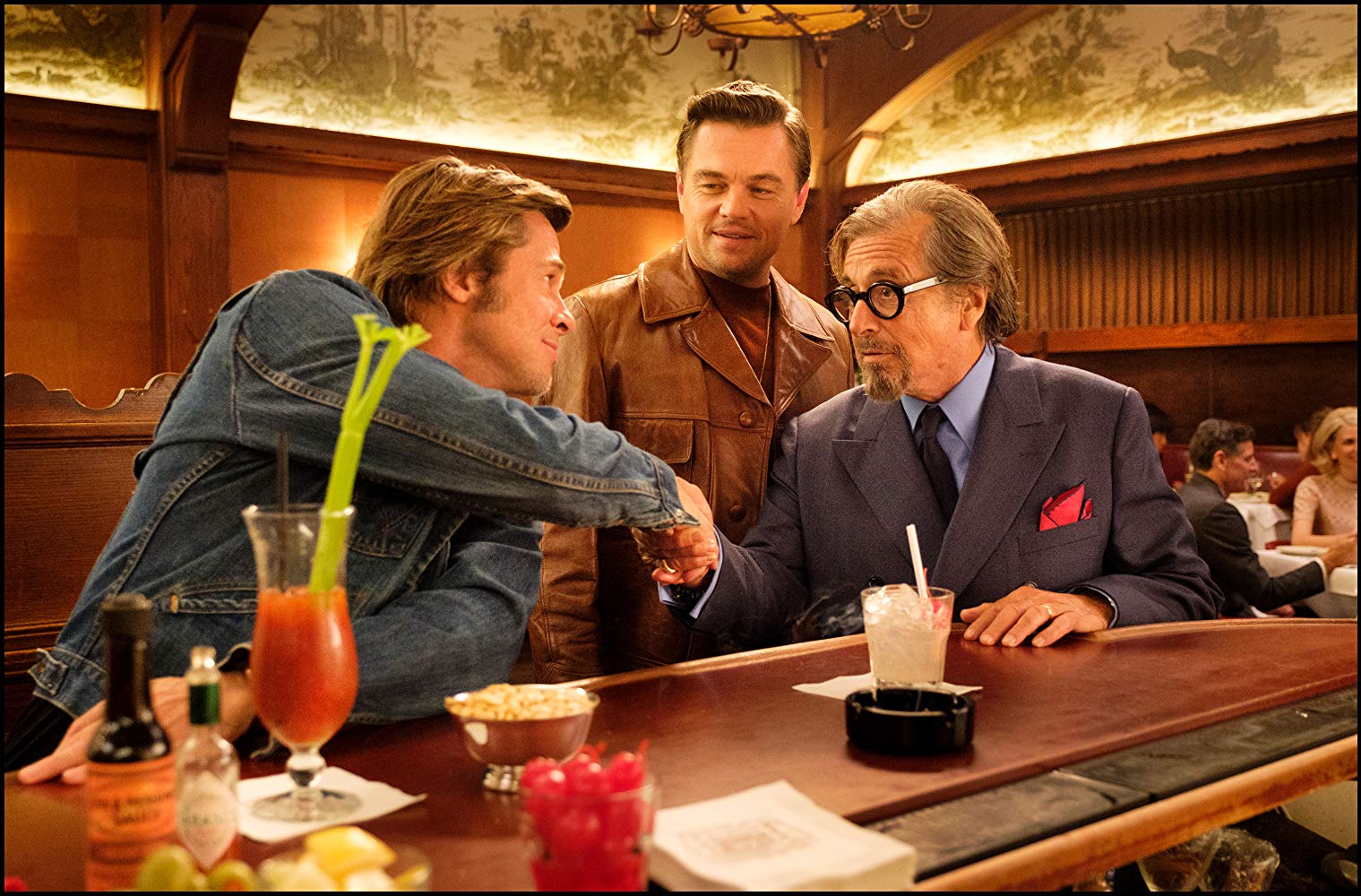
With Once Upon A Time In Hollywood, Quentin Tarantino crafts his most delicate work to date. The love letter to old Hollywood is a pleasure to watch from beginning to end. The film follows Cliff Booth (Brad Pitt) and Rick Dalton (Leonardo DiCaprio) as a stuntman and actor trying to maneuver a changing landscape of Hollywood in 1969. The film also follows the Manson Family murders most notably that of Sharon Tate (Margot Robbie). Tarantino uses the murders as the backdrop for the film but deep at its core this is a love letter to a bygone era of filmmaking.
Once again Robert Richardson’s cinematography reaches incredible heights in this film. Those shots of following Cliff drive through the streets of Los Angeles feels so seamlessly crafted. One aspect of the cinematography that I adored was the use of the dutch angles which transported me to all the Alfred Hitchcock films I watched last semester. The classic film feeling is synonymous with the use of dutch angles and every time that Tarantino pulled them out I was enthralled. The use of music, sound design, and production design is just delightful and honestly I could look at every single frame from this movie for hours on end.
How could I get to this point in this review without speaking on the performances by Pitt, DiCaprio, and Robbie. Margot Robbie truly embodies Sharon Tate and I could feel her presence throughout this whole film. Closer to the film’s end I could feel the waterworks start without knowing that Tarantino would use a revisionist trope here. You truly fall in love with Sharon Tate’s love for her career and that scene of her smiling and loving the reactions to her performance in The Wrecking Crew. It feels as if you are reacting with the audience in the film and get to see the happiness of Tate projected to you. I won’t lie but I truly felt some tears at that point because you see Tate at her most vulnerable and happy in the film. On the other hand, Leo and Brad Pitt create the best duo I have seen in a very long time on the big screen. Brad Pitt does an incredible job as the great friend and biggest supporter of Rick Dalton, but it is Leonardo DiCaprio who shines the brightest throughout this film. Leo steals every scene he is in and goes above and beyond especially during his temper tantrum after he messes up some lines on set of a western.
Now lets talk about that ending (seriously guys SPOILERS AHEAD)…
After coming back with a beautiful Italian wife and a loyal Cliff Booth from shooting spaghetti westerns in Italy, Rick Dalton decides to have one last night in LA with Cliff before he has to let him go because he just cannot afford his services anymore. After a night of Mexican food and margaritas at his residency a drunk Dalton confronts four of the original Manson Family murderers and orders them to get out of his driveway before he calls the cops. They listen but decide to return to kill those who “taught them to kill” AKA Rick Dalton and the actors portraying characters on their TV sets. One of the members manages to run away in a very comedic way so it leaves three to get the job done. A very stoned Cliff is cornered by three of the murders he met months ago when he gave a ride to Pussycat back to their ranch. A bloody fight ensues in the most Tarantino fashion by the help of the world’s greatest dog and a drunk Rick Dalton using a flamethrower from his old WWII film he was in. This saves the life of Sharon Tate and her unborn child which sadly was not the same fate for her in the real life events of August 6th, 1969. As a wounded Cliff is being driven to the hospital and Rick reassures him as him being a great friend, Rick finally gets invited into the Tate-Polanski residence to meet Sharon and have a drink with them, which may or may not reignite his career. Audiences knew that was not what Tarantino was doing with that emotionally charged final shot. That was his way of changing the outcome of a horrific event and allowing the audience to escape into a cathartic experience as we imagine a life without the brutal murder of a lovely actress.
All and all, through a tough second act that has some minor gripes, Once Upon A Time In Hollywood was a visceral experience. One that I did not expect from the 9th film in Tarantino’s filmography. Filled with comedy, bloody action that only Tarantino can craft in his own style, incredible technical merits, and performances that will leave you impressed. Even as the film was ending I did not want those credits to start because I wanted this love letter to never reach its last period. What did you think about the 9th film of Quentin Tarantino? Let us know!



 The Nerd Corps